Time Zone Variations Shape Peak Participation in Global Live Poker Tournaments
Yves Long · Jun 18, 2026

Time Zone Variations Shape Peak Participation in Global Live Poker Tournaments
Live poker tournaments on international platforms draw players from multiple continents, and time zone differences directly influence when those events attract the largest fields. Organizers schedule major buy-in events to align with evening hours in key markets, yet the spread of participants creates staggered activity peaks rather than a single global rush.
Core Regions Driving Participation Patterns
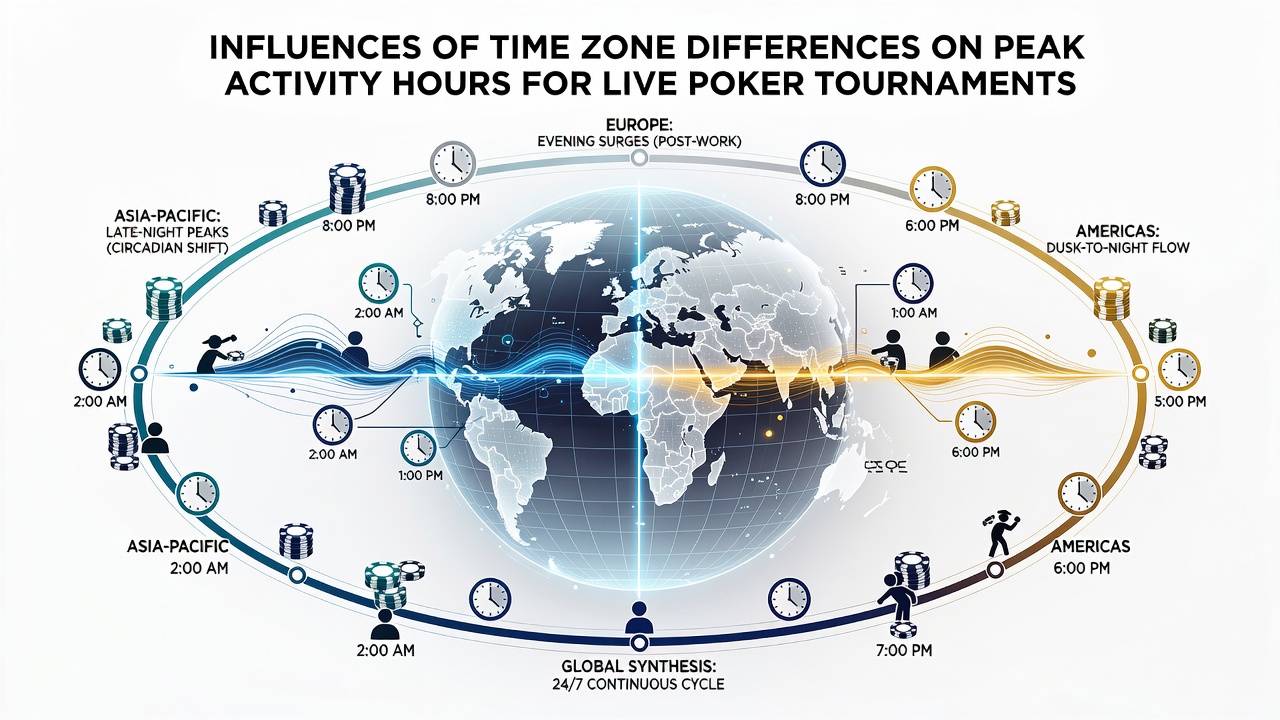
North American players concentrate activity during late afternoon and evening hours in Eastern Time, which translates to overnight periods for European participants. Asian markets, particularly those in the China Standard Time and Japan Standard Time zones, generate strong turnouts during their own evening windows that often fall during morning or midday slots for North American audiences. Data from major networks indicates that tournaments starting between 18:00 and 22:00 in the host time zone consistently record higher registration numbers when those windows overlap with after-work periods in at least two major player regions.
European and North American Overlap Dynamics
European players typically log in after 19:00 local time, creating a window that overlaps with afternoon sessions on the US East Coast. This overlap produces elevated traffic for events scheduled around 15:00 Eastern Time, whereas purely European-start times see reduced American participation because those hours fall during work periods on the opposite side of the Atlantic. Observers tracking registration logs note that fields grow by measurable margins when a single start time captures both post-work European players and pre-dinner American players simultaneously.
Asian Market Influence on Scheduling
Platforms serving large player bases in South Korea, Japan, and Australia adjust start times to capture evening hours in those regions. A tournament beginning at 20:00 Japan Standard Time lands during morning hours for most European players and late-night hours for North Americans, yet still draws substantial fields from Asia-Pacific participants. June 2026 registration figures from several networks showed that events positioned between 19:00 and 23:00 in Tokyo time maintained consistent volume even when North American traffic remained low, confirming that regional density can sustain events without full global overlap.
Data Patterns from Recent Tournament Cycles
Analysis of multi-table tournament series reveals that Sunday major events achieve peak entries when start times fall between 14:00 and 17:00 Coordinated Universal Time, a slot that captures late evening in Europe, early afternoon on the US East Coast, and late night in parts of Asia. Midweek events scheduled outside these windows experience flatter registration curves, with activity concentrated among whichever single region finds the timing convenient. Networks that publish anonymized traffic reports show clear spikes corresponding to these overlaps rather than uniform distribution throughout the day.
One documented case involved a high-stakes series in early 2026 that shifted its primary Sunday event forward by two hours; the adjustment produced a 12 percent increase in total entries while maintaining European participation levels. Similar adjustments in other series produced comparable shifts when the new window better aligned with after-work hours across two continents. These movements demonstrate that small changes in universal time positioning can alter field sizes without requiring alterations to prize structures or format.
Platform Adjustments and Player Behavior
Global networks respond to these patterns by offering multiple starting flights or staggered satellites that accommodate different regional schedules. Players in distant zones often select satellites that begin during their own evening hours and feed into main events timed for other markets. This approach spreads activity across several daily peaks instead of concentrating everything into one window. Tracking services that monitor concurrent player counts confirm that networks using staggered formats maintain steadier traffic throughout a 24-hour cycle compared with those running single daily start times.
Regulatory filings and industry reports from bodies such as the American Gaming Association and research summaries issued by the Australian Gambling Research Centre document how cross-border platforms track these regional rhythms to optimize server load and marketing spend. The reports highlight that peak-hour alignment influences not only entry numbers but also average session length and satellite conversion rates.
Conclusion
Time zone differences create predictable waves of activity rather than uniform global participation in live poker tournaments. Networks that map these waves and position events to capture overlapping evening hours in multiple regions record higher registration volumes. Continued monitoring of player distribution data allows organizers to refine start times as regional player bases expand or contract, ensuring that major events continue to attract fields drawn from the widest possible set of time zones.