Observers Note Distinct Changes in User Activity Allocation Across Game Types Following Revised Reward Structures
Gisela Jung · Jun 4, 2026
Observers Note Distinct Changes in User Activity Allocation Across Game Types Following Revised Reward Structures
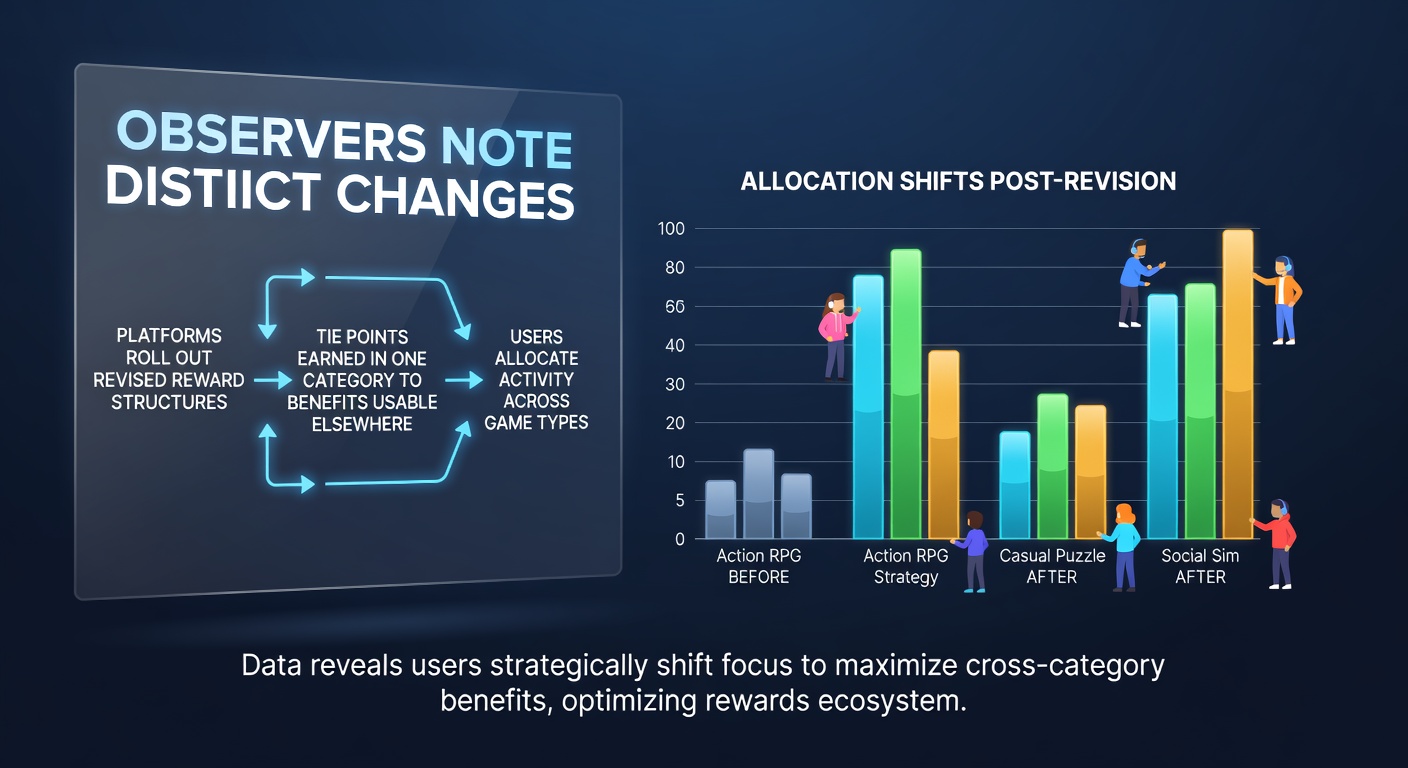
Platforms that link points earned in slots directly to table game perks or live dealer credits have prompted measurable reallocations of player time, according to tracking data released in early 2026. Operators introduced these unified structures in late 2025, and by June 2026 several major sites reported shifts where users who previously concentrated on one vertical began sampling others to maximize transferable benefits.
How Cross-Category Point Systems Operate
Traditional loyalty programs kept earnings siloed by game type, yet newer models convert activity across verticals into a single balance redeemable for bonuses, free spins, or cashback. A player accumulating points through slot spins can now apply those same points toward live dealer table entry fees or sports betting credits, and operators publish the conversion rates openly in their terms. This integration reduces friction that once discouraged exploration, while platforms maintain separate earning multipliers for each category to balance risk exposure.
Implementation varies by jurisdiction. Canadian operators under iGaming Ontario guidelines must disclose all transfer ratios before users opt in, and similar transparency rules appear in several Australian state frameworks administered through state gaming authorities. The result is that users receive clear signals about which activities generate the highest transferable value at any given time.
Patterns Emerging From Platform Data
Analysts examining session logs note that users who once dedicated over 70 percent of their playtime to slots have begun allocating 20 to 35 percent of sessions to table games and live dealer formats once the points become interchangeable. The change appears most pronounced among mid-volume players rather than high rollers, whose activity distributions remain more stable. Platforms that introduced the feature in Q4 2025 documented the first statistically significant movement by February 2026, with further acceleration recorded through June.
One study conducted by researchers at a European university tracked 12,000 accounts over eight months and found that average daily active categories per user rose from 1.4 to 2.1 after the reward linkage activated. The increase occurred without corresponding growth in total deposit volume, suggesting redistribution rather than net expansion of play.
Factors Influencing Allocation Decisions
Users respond to visible multipliers and time-limited conversion bonuses that platforms promote through in-app notifications. When a site doubles points earned on live blackjack toward slot free spins for a weekend, traffic to blackjack tables rises measurably within hours. Conversely, when multipliers favor slots, table game participation dips until the promotion ends.

Payment method preferences also interact with these structures. Accounts using regional e-wallets popular in Southeast Asia show faster uptake of the new flexibility compared with credit card users in North America, though the gap narrows once education campaigns reach each segment. Operators attribute the difference to familiarity with bundled rewards common in other digital entertainment verticals.
Regulatory Context and Reporting Requirements
Regulators in multiple regions now request segmented activity reports that break down play by vertical before and after any loyalty redesign. The New Jersey Division of Gaming Enforcement began collecting such data in March 2026, while the Australian Communications and Media Authority incorporated similar metrics into its quarterly compliance reviews. These filings allow authorities to monitor whether cross-category incentives inadvertently increase exposure among vulnerable player cohorts.
Industry associations such as the European Gaming and Betting Association have published voluntary guidelines encouraging operators to maintain opt-out options and clear point expiry schedules when points span multiple game types. Compliance with these guidelines remains uneven, yet larger platforms have adopted them to streamline approval processes in new markets.
Longer-Term Effects on Platform Design
Game developers have started adjusting title portfolios in response to the observed migration. Studios now receive requests for hybrid mechanics that blend slot elements with table game decision points, allowing a single session to generate points across categories simultaneously. Early prototypes tested in Ontario and New Jersey during spring 2026 showed modest uptake, yet operators continue funding further iterations.
Support teams report an uptick in queries about point transfer rules, prompting platforms to expand FAQ sections and introduce in-game calculators that display projected balances across verticals. These tools reduce support tickets while increasing user awareness of the full reward ecosystem.
Conclusion
Data collected through June 2026 indicates that revised reward structures tying points across categories have produced consistent reallocations of user activity, with the extent varying by player segment, promotion timing, and regional familiarity with unified loyalty mechanics. Regulatory reporting requirements and industry guidelines continue to shape how operators communicate and monitor these systems, while game design evolves to match emerging player patterns. Further quarterly releases from multiple jurisdictions will clarify whether the observed shifts stabilize or continue evolving as more platforms adopt similar frameworks.